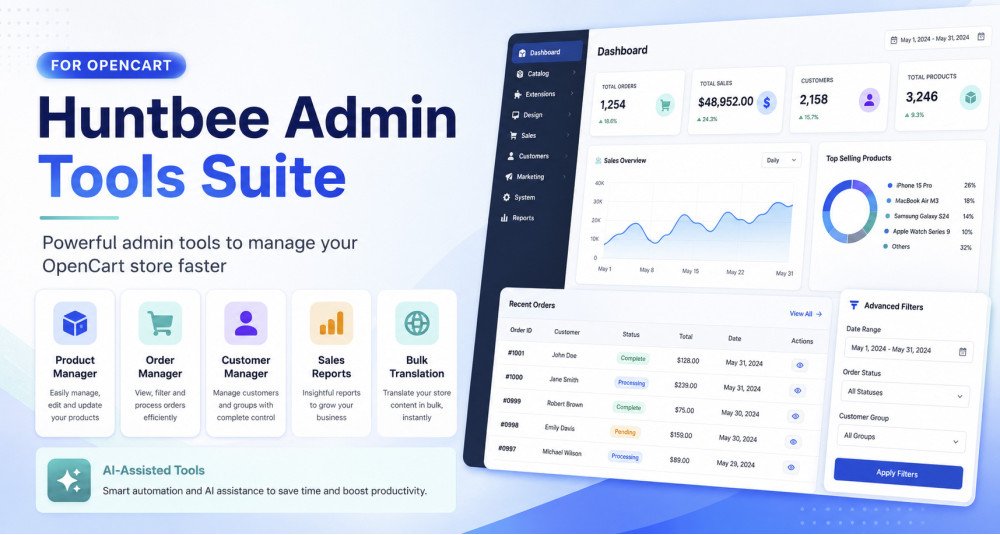
| Manage eight admin tools in one Suite |
Access Product Manager, Order Manager, Customer Dashboard, Sales Performance, Profit & Analytics, Bulk Translate, PDF Invoice and Shipment Manager. |
| View and edit products from a searchable table |
Find catalogue products without opening a separate full product form for each change. |
| Find products needing attention |
Filter low-stock, out-of-stock, disabled, recently added, on-special, image-less or uncategorized products. |
| Filter the catalogue by store and product details |
Narrow results by store, manufacturer, category, availability and other supported criteria. |
| Choose the information shown in product rows |
Display stock, price, identifiers, special price, manufacturer, categories, stores and other optional columns. |
| Edit common product fields directly in the list |
Update supported values by double-clicking an editable table cell. |
| Edit a product in a focused popup |
Manage supported product data, associations, images, language content and attributes without leaving the grid. |
| Edit product descriptions in individual languages |
Maintain translated names, descriptions, tags and meta fields in their corresponding language records. |
| Add a missing product-language record |
Create a supported content row for a language that does not yet have product text. |
| Edit main and additional product images |
Choose, upload, reorder or remove supported images through the product editing tools. |
| Manage product attributes by language |
Look up attributes and edit their values for the appropriate languages. |
| Manage categories, filters and related products |
Add or remove supported product associations in a single editing workflow. |
| Assign products to selected storefronts |
Add, remove or replace store associations so an item appears in the intended shops. |
| Manage promotional prices |
Review and update eligible customer-group specials and promotional date ranges. |
| Review quantity-based discount prices |
See tier prices separately from a current special price so the two are not confused. |
| Maintain stock and availability settings |
Edit product quantity, subtract-stock behavior, stock status and availability-related fields. |
| Preview bulk product operations before saving |
See matching products, changes, skipped items and possible master/variant conflicts. |
| Change many product values at once |
Apply eligible price, status, quantity and similar updates to a chosen product selection. |
| Update product associations in bulk |
Add, remove or replace supported categories, stores, filters and related products. |
| Select all products matching current filters |
Work with a filtered selection beyond the visible page while reviewing the operation first. |
| Monitor product bulk processing |
Review completed, skipped and failed records, cancel unprocessed work and retry eligible failures. |
| Respect master and variant product relationships |
Distinguish master, variant and orphan products and avoid unsupported changes to inherited values. |
| Identify duplicate product identifiers |
Find matching SKU or similar code values and distinguish expected variant inheritance from unrelated duplicates. |
| Quickly add or duplicate products |
Create a basic new product or copy an existing one without reusing conflicting identifiers and SEO URLs. |
| Delete selected products with confirmation |
Use controlled deletion and additional master/variant safeguards instead of removing records without review. |
| Configure Product Manager display defaults |
Choose page size, language, thumbnail dimensions, low-stock threshold and preferred identifier. |
| Search orders by customer or reference |
Find an order by number, invoice, customer name, email or telephone. |
| Filter orders by detailed criteria |
Narrow orders by date, amount, status, store, buyer type, product, payment or delivery information. |
| Open ready-made order worklists |
Review today's orders, unprocessed orders, high-value orders or other common operational views. |
| Create your own reusable order views |
Save filters, sort settings and columns for a repeated task such as checking pending COD orders. |
| Customize the order table |
Choose product, contact, invoice, shipping, payment, age and other available columns. |
| Color-code order statuses |
Choose badges and row colours so important order states stand out. |
| Inspect an order without leaving the list |
Open a panel for overview, customer, addresses, items, history and available related tools. |
| Review shipments from an order |
Open the order's shipment information when Shipment Manager is installed and available. |
| Update status or add order-history notes |
Use OpenCart's supported order-status workflow from within Order Manager. |
| Edit supported order addresses |
Correct permitted payment and shipping details with validation and permission checks. |
| Manage order reward and commission entries |
Review and apply eligible reward point and affiliate commission actions from the order panel. |
| Navigate between nearby orders |
Move to the previous or next eligible order while reviewing customer orders. |
| Change many order statuses together |
Preview eligible orders and apply a chosen status in a managed bulk run. |
| Choose whether bulk updates email customers |
Keep customer notifications off by default, or deliberately enable them for an eligible status update. |
| Review bulk status progress and failures |
See completed, skipped and uncertain orders and retry only work safe to repeat. |
| Permanently delete selected orders through a guarded run |
Preview the selected orders, confirm explicitly and monitor eligible deletion work. |
| Delete selected order history records when authorized |
Use supported confirmation and processing controls for order-history cleanup. |
| Export order data as CSV or Excel |
Download eligible selected or filtered orders as CSV or XLSX. In Admin Tools 4.3.3, Excel export uses the shared streaming writer supplied by HuntBee Framework 4.2.5 or newer. |
| Select the columns in exported orders |
Choose supported order, customer, address and product fields for filtered exports. Excel output uses the Framework's shared writer without a separate Admin Tools XLSX library. |
| Generate invoices and packing slips for selected orders |
Use the optional PDF component's integrated document actions from Order Manager when available. |
| Restrict sensitive order operations |
Configure which user groups can perform destructive actions and full-data exports. |
| Check Order Manager readiness |
Review API availability, database capabilities, event logging and recommended indexes. |
| Control expensive history filters on very large stores |
Limit status-age queries when large history tables lack the recommended index. |
| Find customers using search and detailed filters |
Search by contact details, group, store, country, purchases, status and amount spent. |
| Identify repeat, loyal, VIP and inactive buyers |
Segment customers based on eligible order counts and the time since their last purchase. |
| See customer lifetime value and purchase frequency |
Review purchases, average order value, repeat rate and other customer metrics. |
| Inspect a customer's order and account history |
Open a profile with available orders, purchased products, contact information and account details. |
| Review carts and wishlists for a customer |
See supported shopping-cart, wishlist and product-interest information where available. |
| Inspect account activity and reward information |
Review available addresses, searches, IPs, reward entries and customer activity. |
| Email a customer from their profile |
Send a message with a subject and body through the available admin action. |
| Manage accounts and selected customer deletions |
Open native account editing or remove chosen customers with appropriate authorization. |
| Analyze customer growth and returning customers |
Compare first-time versus repeat buyers, customer registrations and customer segments over time. |
| Compare guest buyers with registered customers |
Measure guest orders and revenue within a selected reporting period. |
| Find customers who bought a selected product |
Use product-buyer analysis and view customer distribution by eligible country and segment. |
| Customize customer segment thresholds |
Set the windows for new and inactive customers and the order counts for repeat, loyal and VIP groups. |
| Export customer and buyer reports when permitted |
Restrict personal-data downloads to configured administrative user groups. |
| Review customer metric refresh and rebuild status |
See pending metrics, rebuild progress and recommended indexes. |
| Monitor orders, revenue and units sold |
Review total orders, order revenue, average order value, distinct buyers and products sold. |
| Filter performance by store and order status |
Choose one or all stores, time periods and the order statuses used for calculations. |
| Compare sales with previous periods |
Compare current results against an earlier period or the same period last year. |
| See monthly and yearly sales charts |
Explore month-by-month, year-by-year and all-time sales trends. |
| Find the products responsible for sales |
Review top sellers, high-revenue products and low-performing items. |
| Identify products with declining or no sales |
Use product health reports to find dormant products, declining sellers and new successes. |
| Compare sales by buyer type and other dimensions |
Analyze guest versus registered buyers and other supported performance breakdowns. |
| Review coupon use and related sales |
See coupon order counts, discount amounts and revenue from orders using coupon codes. |
| Understand order totals separately from product revenue |
Review product-line sales, full order totals and supported order-total breakdowns. |
| See returned quantities alongside sales figures |
Review returned units as a separate measure instead of automatically subtracting them from sales revenue. |
| Export supported sales reports |
Download available performance summaries and product analysis data. |
| Record product purchase costs |
Maintain unit costs to calculate gross profit rather than treating the selling price as profit. |
| Keep cost history with effective dates |
Record when a cost became applicable so earlier sales can use suitable historical values. |
| Manage costs for different stores |
Use store-specific costs and eligible default-store inheritance where currency settings permit. |
| Update many product costs together |
Preview and apply fixed-amount or percentage cost adjustments. |
| Import and export product cost records |
Use supported CSV import and export tools for larger cost updates. |
| Capture costs for existing orders |
Run a controlled historical capture so past sales can be included in profitability reports. |
| Recalculate order profit after fixing historical costs |
Choose an explicit Recost operation rather than changing old captured order figures silently. |
| See gross profit, cost of goods and profit margin |
Compare qualifying sales revenue with recorded product costs and known profit. |
| Find low-margin, profitable and loss-making products |
Review item performance by gross profit, margin, missing cost and decline over time. |
| See the profitability of individual orders |
Inspect order revenue, item costs, gross profit and margin where cost data is sufficient. |
| Open a detailed order profit calculation |
See product lines, discounts, classified totals and recorded cost sources behind the result. |
| Identify missing or unreliable profit information |
Check cost coverage, missing historical costs, estimates, currency issues and other data-quality problems. |
| Classify totals from other extensions |
Choose whether suitable extra order totals count as income, discount, cost or should be ignored. |
| Control use of costs recorded after an order |
Exclude later costs from historical profit or include them as explicitly estimated values. |
| Restrict access to profit and cost downloads |
Choose user groups allowed to export commercially sensitive data. |
| Tune profit reporting for large stores |
Use configurable report caching and apply suggested database indexes when needed. |
| Translate catalogue text to selected store languages |
Choose a source language and one or more target languages for supported content. |
| Translate multiple kinds of catalogue records |
Work with products, categories, information pages, articles, topics, attributes, options and filters. |
| Choose which fields to translate |
Select supported names, descriptions, meta tags and other language fields rather than replacing the entire record. |
| Choose AI or Google Cloud Translation |
Use an AI provider configured in HuntBee Framework or a Google Translation API key. |
| Fill missing translations or deliberately overwrite them |
Select a missing-only operation to preserve existing text, or overwrite when replacing translations is intended. |
| Review translation coverage before processing |
See which supported content and language fields are populated or still need translation. |
| Monitor the translation queue |
See pending, completed and failed translation jobs rather than running the whole catalogue in one web request. |
| Retry failures and restore supported translations |
Retry unsuccessful jobs and restore earlier translated values from activity records where available. |
| Translate repeated catalogue terminology |
Translate supported reusable attribute, option and filter terms through the Catalog Terms workflow. |
| Inspect translation activity and error logs |
View and clear processing records to troubleshoot provider failures or unusual translation results. |
| Generate invoices from saved order information |
Create PDF invoices using the order details stored at checkout rather than today's product data. |
| Create packing slips for preparing parcels |
Produce separate packing documents with optional product prices and contact details. |
| Combine several invoices or slips into one PDF |
Generate a multi-order PDF with separate order sections or pages. |
| Preview PDFs before saving or printing |
Check a document against a real order before distributing it. |
| Use and customize document designs |
Choose built-in invoice or packing-slip templates and duplicate them to create your own. |
| Customize PDF layout and appearance |
Control item columns, product images, colours, page orientation, paper size and spacing where supported. |
| Add store branding and custom header or footer text |
Show a store logo, business contact information and safe formatted content with placeholders. |
| Display special text for matching orders |
Add rules such as showing bank-transfer details only on bank-transfer invoices. |
| Use document overrides for individual stores |
Keep shared settings with optional per-store template and branding choices. |
| Choose the document language |
Use the language saved with the order or the configured administrative language. |
| Add a watermark to invoices or packing slips |
Place optional text or a local image watermark with configured opacity. |
| Include a barcode or QR code in documents |
Encode supported order-related values in a QR code or barcode. |
| Create shipments with courier and tracking details |
Record the courier, tracking number, shipped date, expected delivery and product quantities for a parcel. |
| Ship order items in multiple parcels |
Record partial quantities and see already shipped and remaining quantities for each order line. |
| Maintain couriers and tracking URL formats |
Add couriers, enable or disable them and configure their tracking links. |
| Find shipments quickly |
Filter shipments by store, customer, courier, date, tracking number or email delivery status. |
| Edit recorded shipment details |
Update permitted shipment information and explicitly unlock shipped quantities when they need correction. |
| Choose a standard or compact shipment form |
Select a detailed form or a compact layout with a preferred starting quantity. |
| Send or resend shipment emails immediately |
Send a shipment notification directly using the store's mail settings, view Sent or Failed status and manually resend when needed. Sent means the mail transport accepted the message. |
| Choose single-product and multiple-product shipment email templates |
With separately installed Email Suite 4.3.1 or newer, choose published templates in Shipment Manager's Email tab, preview or edit them and use their own subject lines. Without Email Suite, the built-in email remains available. |
| Optionally update the order status when creating a shipment |
Choose an allowed order status and whether shipment details should be included in the order history comment. |
| Customize shipment history text per language |
Set the wording and placeholders used when shipment information is recorded in order history. |
| Configure shipment settings for individual stores |
Keep shared settings or override supported store settings, including the selected single-product and multiple-product email templates when Email Suite is available. |
| Delete a shipment while preserving historical records |
Remove the parcel record and restore remaining shippable quantities without undoing already sent emails or order history. |